Ruai sits along Kangundo Road on the eastern side of Nairobi. It is one of the areas that has grown fast as people move out of the crowded inner estates looking for more space. If you are searching for houses to rent in ruai, this guide explains what daily life is like, what to check before you sign, and which nearby areas to compare.
Ruai at a glance
- Where: East of the city, along Kangundo Road, within Nairobi County.
- Feel: A growing area with a mix of new flats, gated compounds, bungalows and open plots still being built on.
- Main draw: More space for the money than many estates closer to town.
- Main trade-off: A longer commute and services that can lag behind the building boom.
Rents: As of 26 Oct 2026, ISHI Homes has no published listings in Ruai yet, so we are not quoting rent figures here. Live houses appear on the Ruai area page on ISHI Homes as agencies list them. Check there for current prices and move-in costs.
Who Ruai suits, and who it does not
Ruai may suit you if:
- You want a bigger house, a compound or a small garden for your budget.
- You have a family and want a quieter place than the busy inner estates.
- You work on the eastern side of Nairobi, or you work from home.
- You are thinking of buying land or building in the area later and want to know it first.
Ruai may not suit you if:
- You must be in the city centre early every day and hate long journeys.
- You need everything, from nightlife to big malls, within walking distance.
- You cannot handle any water or power gaps without a backup plan.
Getting around
Kangundo Road is the main link between Ruai and the rest of Nairobi. Most people use matatus, motorbikes (boda bodas) for short trips, or their own cars.
Things to know:
- Peak hours matter. Traffic on Kangundo Road can be heavy in the morning and evening. A trip that is quick at midday can take much longer at rush hour.
- Inner roads vary. The main road is tarmac, but many estate roads are murram (dirt). They can get dusty in the dry season and muddy when it rains.
- Last-mile distance. Some houses are a long walk or a boda ride from the main road. That adds cost and time every day.
How to check: Do your real commute before you rent. Travel from the house to your workplace at the time you would normally leave, and come back in the evening. Note the cost and the time.
Water and power
Water is the question to ask first in any fast-growing area, Ruai included.
- Ask whether the house gets county water, borehole water, or both.
- Ask how often county water comes and how many days a week.
- Check for a storage tank and its size. A large tank helps a lot during dry spells.
- If the water is from a borehole, ask if it is salty or hard (heavy in minerals), and whether it is treated.
- Ask who pays for water and how it is billed: a fixed amount or a meter.
For power, ask whether the house has its own prepaid token meter. Ask neighbours how often outages happen. Shared meters can cause arguments over bills.
Safety
Safety in Ruai, like anywhere, changes from street to street. Do not rely on general talk. Check for yourself:

- Is the compound gated, with a working gate and a guard at night?
- Are there street lights on the way from the main road to the house?
- Is the route you would walk at night busy or empty?
- Ask a few neighbours and the caretaker what problems, if any, they have seen.
Visit once in daylight and, if you can, once after dark.
Shopping and daily life
As Ruai has grown, so have shops along Kangundo Road and inside the estates. You will usually find small supermarkets, kiosks, open-air markets, butcheries and hardware shops. For bigger shopping trips, many residents travel to larger centres nearby or towards town.
When you view a house, walk to the nearest shops and see what is available for everyday needs such as bread, milk, gas and vegetables.
Schools and health
There are public and private schools in and around Ruai, plus clinics and medical centres. Quality and fees differ a lot.
- Visit any school before you decide, and ask about fees, transport and class sizes.
- Find the nearest clinic and the nearest larger hospital, and check how long it takes to get there at night.
- If you have children, check the school route for safety and traffic.
Internet
Fibre internet has been spreading in many growing parts of Nairobi, but coverage can be patchy from one estate to the next.
- Ask the landlord or caretaker which providers already serve the building.
- Ask neighbours how reliable it is.
- Check mobile data signal inside the house on your own phone.
If you work from home, make this a deal-breaker question.
Pros and cons of living in Ruai
| Pros | Cons |
|---|---|
| More space for the money | Longer commute to the city centre |
| Newer houses and gated compounds | Traffic on Kangundo Road at peak hours |
| Quieter than inner estates | Water supply can be unreliable in places |
| Room to grow as the area develops | Some inner roads are rough, dusty or muddy |
| Good base if you plan to build nearby | Fewer big malls and entertainment spots close by |
Nearby alternatives to compare
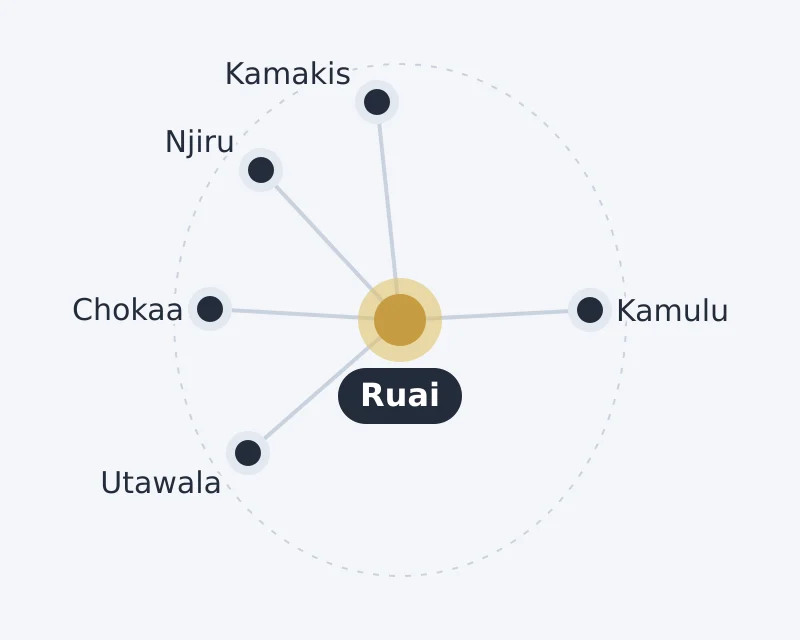
If Ruai is close but not quite right, compare these nearby areas:
- Chokaa: Also on the Kangundo Road side. Worth comparing for space and price.
- Kamakis: Known for its eateries and evening social life. Compare if you want more going on nearby.
- Kamulu: Further out along Kangundo Road. Often looked at by people wanting even more space.
- Njiru: Closer to the inner eastern estates. Compare if a shorter commute matters more.
- Utawala: A large residential area nearby with many gated compounds. Compare for family housing.
Check each area page on ISHI Homes for houses as they are listed, and use the same checklist on water, commute and safety.
Before you pay anything
- Never pay before viewing. Do not send a deposit or "booking fee" for a house you have not seen.
- View the house in person. Check the water, meter, locks and compound yourself, and meet the landlord or agent face to face.
- Use verified listings. Find verified houses on ISHI Homes at homes.ishi.digital.