
Before you get the keys to a new house, you usually pay more than one month's rent. The extra money is the rent deposit. This guide explains how much a rent deposit in Kenya normally is, how it differs from water and power deposits, when you should get it back, and how to keep records so you are not left out of pocket.
What a deposit is
A deposit is money you give the landlord at the start that they hold, not spend. It protects the landlord if you leave unpaid rent, unpaid bills or damage beyond normal use. If you leave the house in good shape and owe nothing, the deposit should come back to you.
It is not rent. Your first month's rent is paid separately.
How much rent deposit in Kenya is normal
Most landlords ask for one month's rent as a deposit. In higher-end areas, two months is common.

Here is what ISHI Homes listings show, as of 25 Oct 2026. "Move-in" means first month's rent plus deposit.
| House type | Median rent a month | Typical move-in (rent + deposit) |
|---|---|---|
| Bedsitter | KES 8,500 | KES 17,000 |
| 1 bedroom apartment | KES 15,750 | KES 31,500 |
| 2 bedroom apartment | KES 28,000 | KES 56,000 |
| 3 bedroom house | KES 45,000 | KES 90,000 |
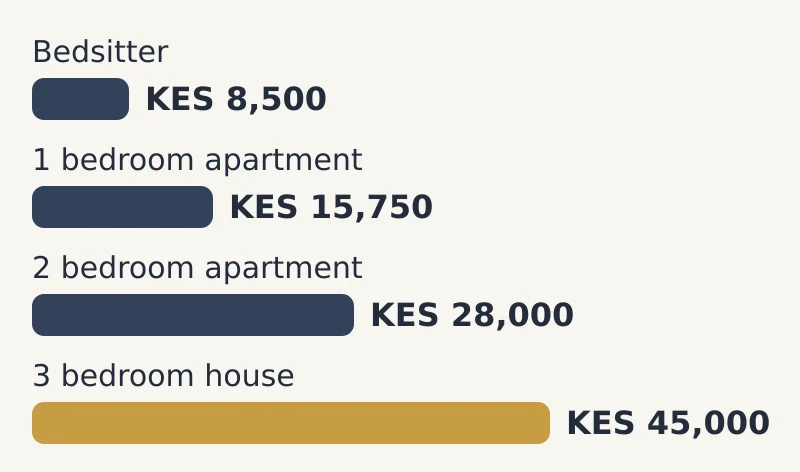
For most of these, move-in is about twice the monthly rent. That means a deposit of one month.
Some areas are different. In Kilimani, a 2 bedroom apartment had a median rent of KES 71,500 and typical move-in of KES 214,500, as of 25 Oct 2026. That is about three times the rent, meaning a deposit of two months.
By comparison, in commuter areas like Toll (Ruiru), a 2 bedroom apartment had a median rent of KES 21,250 and typical move-in of KES 42,500. In Kahawa Wendani, a bedsitter was KES 8,500 with move-in of KES 17,000 (both as of 25 Oct 2026).
These figures come from a small number of listings, so treat them as a guide, not a fixed price.
A simple rule: budget for at least two months' rent before you start house hunting, and three months if you are looking in upmarket areas. Then add water, power and moving costs.
Rent, water and power deposits are different
Many tenants are surprised by extra deposits. Ask about each one before you agree.
Rent deposit
- Usually one or two months' rent.
- Held by the landlord or agent.
- Covers unpaid rent and damage.
Water deposit
- A separate, smaller amount some landlords charge.
- Covers unpaid water bills when you leave.
- In some buildings it goes to the landlord, in others it is for opening an account with the water company.
- Ask: Who holds it? Is it refundable? Is water billed by a meter or a fixed amount?
Power (electricity) deposit
- Many newer houses use prepaid meters (you buy tokens). These often need no power deposit.
- Older houses with postpaid meters (you get a monthly bill) may need a deposit.
- Ask: Is the meter prepaid or postpaid? Is the meter in my name or shared? Are there any unpaid bills on it?
Other charges to ask about
Some landlords or agents also ask for:
- Agency or viewing fees
- Garbage or service charges
- Key or gate card deposits
Ask which of these are refundable (you get the money back) and which are not. Get the answer in writing.
When you should get your deposit back
There is no single rule that every Kenyan tenant can point to. In practice, your tenancy agreement (the rental contract) is the main guide. Read it before you sign and look for:
- The exact deposit amount
- How many days after you move out the landlord will refund it
- What they can deduct for
- How much notice you must give before moving out
If the agreement is silent on timing, ask the landlord to add a refund date. Many tenants agree on a refund within a set number of days after handover, once final water and power bills are cleared.
What a landlord can fairly deduct
- Unpaid rent
- Unpaid water or power bills
- Damage beyond normal use, like a broken window or door
- Lost keys or gate cards
What they should not deduct
- Normal wear and tear, such as faded paint or small marks from years of living
- Problems that were already there when you moved in
- Vague "repainting" or "cleaning" fees not in your agreement
Should I use my deposit as last month's rent?
Many tenants do this, but it is risky. Most agreements do not allow it. It can lead to disputes, and the landlord may claim damage and say you still owe money. It is safer to pay your last month and ask for the deposit back in full.
How to document your deposit
Good records are the best way to get your money back.
When you pay
- Pay through M-Pesa (Paybill or Till) or bank, not cash.
- Make sure the name on the payment matches the landlord or agency.
- Get a written receipt that says "deposit" and the amount.
- Keep the M-Pesa message or bank slip.
When you move in
- Walk through the house with the landlord or caretaker.
- Take dated photos and videos of every room: walls, floors, taps, sockets, doors, windows.
- Note any damage on a checklist and have both of you sign it.
- Write down the water and power meter readings and take photos.
- Keep a copy of the signed tenancy agreement.
When you move out
- Give notice in writing (SMS, WhatsApp or letter) as the agreement says, and keep a copy.
- Clear your water and power bills and keep the receipts.
- Clean the house and fix anything you broke.
- Do a final walk-through with the landlord and take new photos.
- Record the final meter readings.
- Hand back keys and cards and get a written note that you did.
- Ask in writing when the deposit will be refunded and to which M-Pesa number or account.
If the deposit is not refunded
- Send a polite written reminder with your move-in and move-out photos.
- Ask for a written list of any deductions and receipts for repairs.
- If there is still no answer, seek free legal advice, a tenants' help group, or the right tribunal or small claims court. Your records will matter here.
Before you pay anything
- Never pay before viewing. No deposit, no booking fee, no "holding" money for a house you have not seen.
- View the house in person. Check the rooms, the meters and the water supply yourself, and meet the landlord or agent.
- Find verified houses on ISHI Homes. Browse listings with clear rent and move-in figures at homes.ishi.digital.