If you are asking "how much rent can I afford in Kenya?", start with the money that actually reaches your account, not the salary on your offer letter. Your gross pay (the full salary before deductions) shrinks once PAYE, SHIF, NSSF and the housing levy are taken off. This guide shows you a simple rule, a ready table, and what to do before you sign.
The rule of thumb: 30% of take-home pay
Aim to spend about 30% of your take-home pay on rent. Treat 35% as the upper limit.
- Take-home pay (net pay) is what is left after statutory deductions.
- At 30%, you still have room for food, transport, bills, savings and emergencies.
- Above 35%, one hospital bill or a late salary can leave you behind on rent.
If you have a loan, SACCO deduction, HELB repayment or support family at home, aim lower, around 25%.
What comes off your salary
These are the main deductions on a Kenyan payslip:
- PAYE (Pay As You Earn): income tax your employer deducts and pays to KRA.
- SHIF (Social Health Insurance Fund): health cover contribution, charged as a percentage of gross pay.
- NSSF (National Social Security Fund): your pension contribution, capped at a set amount.
- Housing levy: a percentage of gross pay for the affordable housing programme.
The table below uses these rates: PAYE bands of 10%, 25% and 30% with personal relief of KES 2,400 a month, SHIF at 2.75%, housing levy at 1.5%, and NSSF at 6% of pay up to KES 72,000. SHIF, housing levy and NSSF are deducted before PAYE is worked out. Rates can change, so always check your own payslip.
How much rent can I afford in Kenya? Salary table
Figures are approximate monthly amounts, rounded.
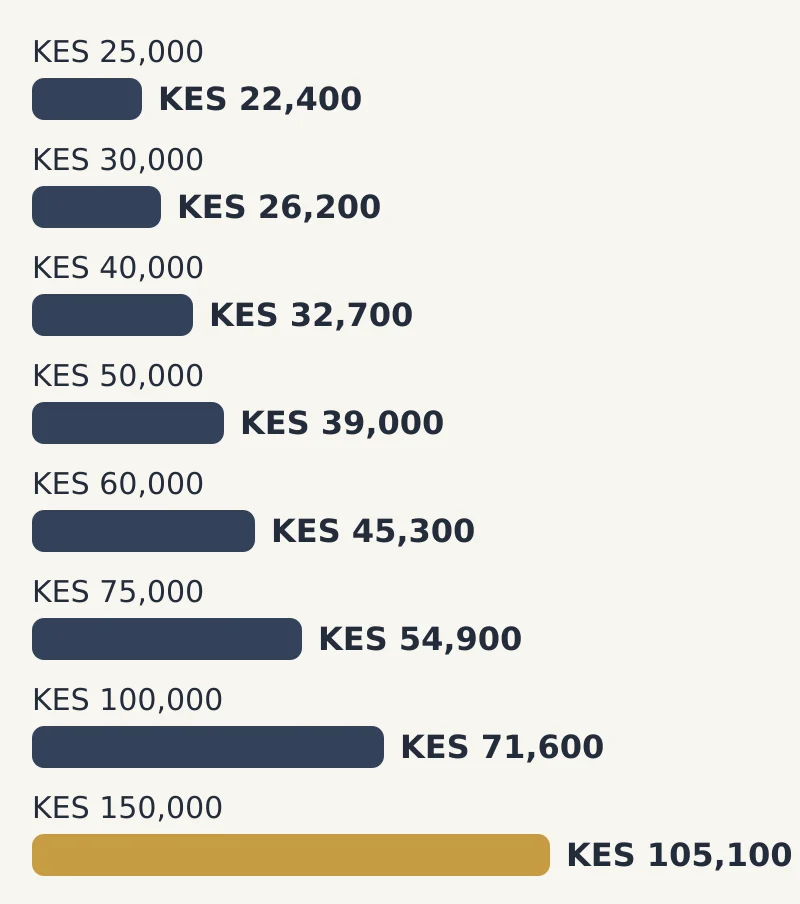
| Gross salary | Approx. take-home | Comfortable rent (30%) | Upper limit (35%) |
|---|---|---|---|
| KES 25,000 | KES 22,400 | KES 6,700 | KES 7,900 |
| KES 30,000 | KES 26,200 | KES 7,900 | KES 9,200 |
| KES 40,000 | KES 32,700 | KES 9,800 | KES 11,500 |
| KES 50,000 | KES 39,000 | KES 11,700 | KES 13,700 |
| KES 60,000 | KES 45,300 | KES 13,600 | KES 15,900 |
| KES 75,000 | KES 54,900 | KES 16,500 | KES 19,200 |
| KES 100,000 | KES 71,600 | KES 21,500 | KES 25,100 |
| KES 150,000 | KES 105,100 | KES 31,500 | KES 36,800 |
| KES 200,000 | KES 138,600 | KES 41,600 | KES 48,500 |
| KES 300,000 | KES 205,700 | KES 61,700 | KES 72,000 |
If your payslip has other deductions, use your actual net pay and multiply by 0.3.
What that buys you: ISHI Homes rents
Here is what houses cost on ISHI Homes, as of 25 Oct 2026 (median rent means the middle price of listings):
| House type | Median rent | Typical rent plus deposit |
|---|---|---|
| Bedsitter | KES 8,500 | KES 17,000 |
| 1 bedroom apartment | KES 15,750 | KES 31,500 |
| 2 bedroom apartment | KES 28,000 | KES 56,000 |
| 3 bedroom house | KES 45,000 | KES 90,000 |
Matched to the table:
- Bedsitter (about KES 8,500): fits a gross salary of around KES 30,000.
- 1 bedroom (about KES 15,750): fits around KES 60,000 to 75,000.
- 2 bedroom (about KES 28,000): fits around KES 110,000 to 130,000.
Area matters a lot. As of 25 Oct 2026 on ISHI Homes:
- Toll (Ruiru): bedsitter KES 7,750, 1 bedroom KES 12,500, 2 bedroom KES 21,250.
- Kahawa Wendani: bedsitter KES 8,500, 1 bedroom KES 13,250.
- Kahawa Sukari: 1 bedroom KES 15,750, 2 bedroom KES 25,000.
- Roysambu: bedsitter KES 12,000, 1 bedroom KES 18,250, 2 bedroom KES 30,000.
- Kilimani: 2 bedroom KES 71,500, 3 bedroom KES 120,000.
Some of these are based on only one or two listings, so treat them as a rough guide.
Don't forget move-in costs
The first month costs far more than the rent. Plan for:
- Deposit: often one month's rent, sometimes two. In Kilimani on ISHI Homes, rent plus deposit is typically three times the monthly rent.
- First month's rent, paid upfront.
- Water and electricity deposits, if the landlord asks for them.
- Moving costs: transport, helpers, curtains, a gas cylinder.
A simple target: save about 2 to 3 times the monthly rent before you start looking.
Check the full cost, not just rent
A cheaper house can end up costing more. Before choosing, check:
- Transport: add up daily fare to work for a full month. Cheaper rent further out can be eaten by fares.
- Water: is it reliable, or will you buy water?
- Service charge or garbage fees: ask if these are included.
- Electricity: token meter or shared bill?
Add these to the rent. The total should still sit near 30 to 35% of take-home pay.
Special cases
- Couples or flatmates: add both take-home pays, then apply 30%. Only do this if both incomes are steady.
- Irregular income (business, gig work, commission): use your lowest month in the last six, not your best.
- Expecting a raise? Wait until it shows on your payslip before moving up.
Before you pay anything
- Never pay before viewing. No deposit, booking fee or "viewing fee" until you have seen the house.
- View the house in person. Check water, power, security and the area at different times of day.
- Use verified listings. Find verified houses on ISHI Homes at homes.ishi.digital.