
If you are looking for houses to rent in Kileleshwa, this guide covers what daily life is like. Kileleshwa is a leafy, mostly residential part of Nairobi with many apartment blocks. Many families and working professionals live here. Below we look at transport, water, power, safety and how it compares with nearby areas, so you know what to check before you sign.
Kileleshwa at a glance
- Type of area: quiet, green and residential, with mainly apartments in gated compounds.
- Who lives here: families, young professionals and people who work in nearby business areas.
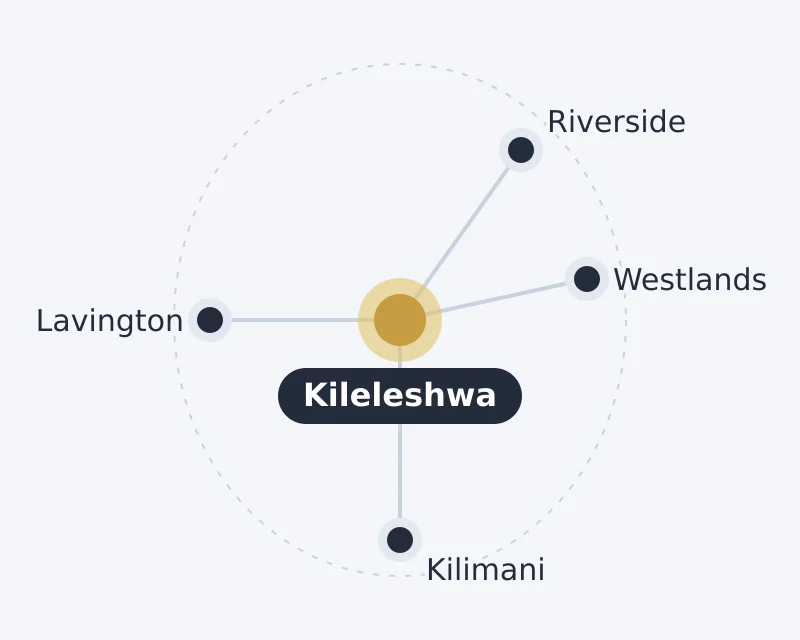
- Nearby areas: Kilimani, Lavington, Riverside and Westlands.
- Rent: As of 25 Oct 2026, ISHI Homes has no published listings in Kileleshwa yet, so we do not quote rents here. Live houses will appear on the Kileleshwa area page on ISHI Homes as agencies list them.
When you do see a listing, ask about the full move-in cost. This usually means the first month's rent plus a deposit (money the landlord holds and should return when you leave, minus any damage). Some landlords also ask for a water or power deposit.
Who Kileleshwa suits, and who it does not
It suits you if:
- You want a calmer, greener place to live close to the city.
- You have a family and want a gated compound with space for children to play.
- You work in Westlands, Kilimani, Upper Hill or the city centre and want a shorter trip.
It may not suit you if:
- You are on a tight budget. It is generally not one of Nairobi's cheaper areas.
- You want lots of nightlife on your doorstep. Kileleshwa is mostly quiet; busier spots are in nearby areas.
- You rely fully on walking to shops and markets. Some parts are spread out.
Getting around
Kileleshwa is close to the city centre and to several business areas. Many residents drive or use ride-hailing apps. Matatus serve the main roads through and around the area.
What to check:
- Your daily route: do the trip to work at rush hour before you commit. Traffic in this part of Nairobi can be heavy at peak times.
- Walk to the main road: some compounds are a fair walk from where matatus stop. Check if the path is lit at night.
- Parking: if you have a car, ask how many parking slots come with the house and if visitors can park.
Water and power
Like much of Nairobi, water supply can be uneven, and rationing (water coming only on certain days) happens in many areas.

Ask the landlord or caretaker:
- Does the building have a borehole (its own underground water source) or large storage tanks?
- How many days a week does county water flow?
- How is water billed - fixed amount or by meter?
For power, ask:
- Is the meter prepaid (tokens) or postpaid?
- Is there a backup generator for lifts, gates and security lights?
- How often do outages happen? Ask a neighbour, not just the agent.
Safety
Most apartments in Kileleshwa are in gated compounds with guards. Still, safety varies from building to building and street to street.

Check these when you view:
- Is there a guard at the gate day and night?
- Are there working CCTV cameras, an electric fence or a secure wall?
- Are the stairs, parking and compound well lit?
- Do visitors have to sign in?
Walk around the area in the evening too. Ask current tenants how safe they feel.
Shopping and daily life
Residents have access to supermarkets, small shops, groceries and cafes within the area and in nearby Kilimani, Lavington and Westlands. Many people also use delivery apps for food and shopping.
Tip: when viewing, note how far the nearest shop is for small daily needs like bread, milk and airtime.
Schools and health
There are schools, clinics and hospitals within reach of Kileleshwa and in neighbouring areas. If you have children, visit the schools you are considering and time the school run from the house. Also find out where the nearest clinic and 24-hour hospital are before you move.
Internet
Fibre internet is commonly available in apartment blocks in this part of Nairobi, but not every building is connected to every provider.
- Ask which fibre providers are already in the building.
- Ask neighbours how reliable it is.
- Check mobile signal inside the house, especially if you work from home.
Pros and cons of living in Kileleshwa
| Pros | Cons |
|---|---|
| Quiet and green | Generally not a budget area |
| Close to the city and business areas | Rush-hour traffic |
| Many gated apartment compounds | Water rationing in some buildings |
| Good for families and professionals | Some spots are a walk from matatu stops |
Nearby alternatives
| Area | How it compares with Kileleshwa |
|---|---|
| Kilimani | Busier, with more shops, restaurants and nightlife. A wide mix of apartments, often more crowded. |
| Lavington | Also leafy and quiet, with more standalone houses and townhouses. Often seen as more upmarket. |
| Riverside | Small, quiet and close to Westlands. Tends to be more expensive. |
| Westlands | A major business and entertainment hub. Good if you want to live near work and nightlife, but noisier. |
If you like Kileleshwa's calm but want more going on, look at Kilimani. If you want more space and a bigger budget allows, look at Lavington.
Before you pay anything
- Never pay before viewing. Do not send rent, a deposit or a "booking fee" for a house you have not seen.
- View the house in person. Check the water, power, security and the area yourself, and meet the landlord or agent.
- Use verified listings. Find verified houses on ISHI Homes at homes.ishi.digital.