If you are looking for houses to rent in Kiambu Town, you are probably after a quieter pace than Nairobi without moving too far away. Kiambu Town is the county headquarters of Kiambu County. It mixes old town life, government offices and newer flats, with farms and estates around it. This guide covers what living in Kiambu Town is like and what to check before you rent.
Kiambu Town at a glance
| Item | What to know |
|---|---|
| Type of place | County town with offices, a market and nearby farms |
| Pace | Quieter than Nairobi estates |
| Main route to Nairobi | Kiambu Road |
| Rents on ISHI Homes | No listings published yet, as of 26 Oct 2026 |
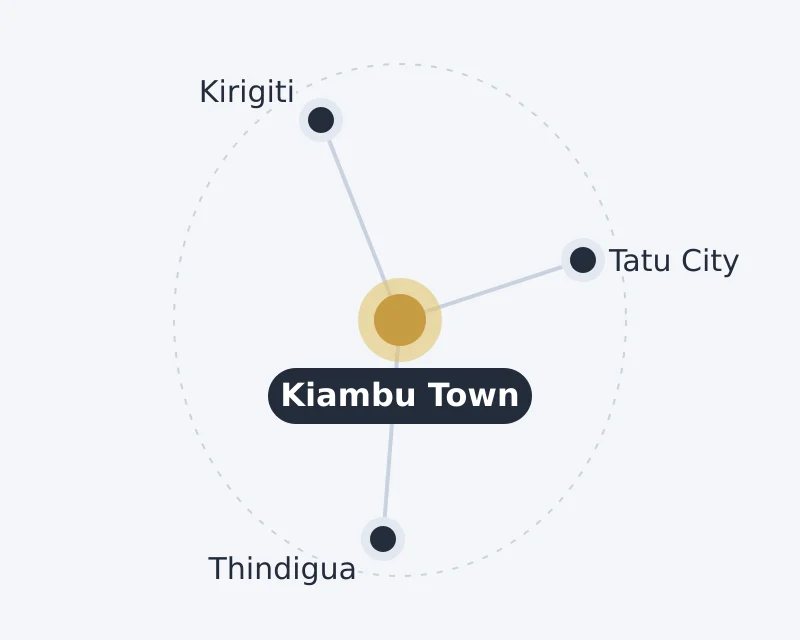
| Nearby options | Kirigiti, Thindigua, Tatu City |
As of 26 Oct 2026, ISHI Homes has no published listings in Kiambu Town, so we do not quote rents here. Live houses appear on the Kiambu Town area page as agencies list them. Check back there to compare real prices.
Who it suits and who it does not
It suits:
- People who work in Kiambu Town itself, such as county or court staff.
- Families who want a calmer place and a bit more space.
- Nairobi workers who can live with a daily commute on Kiambu Road.
- People who like a small-town feel with a market and local shops.
It may not suit:
- People who need to be in central Nairobi early every day and hate traffic.
- Anyone who wants busy nightlife or large malls on the doorstep.
- Renters who need very fast, cheap home internet in every building.
Getting around
Most people travel to and from Nairobi on Kiambu Road. Matatus run between Kiambu Town and Nairobi, and there are local matatus and boda bodas (motorbike taxis) for short trips.
Traffic on Kiambu Road can be heavy at rush hour, especially closer to Nairobi. Travel times change a lot by time of day.
What to check:
- Do the trip at your real rush-hour time before you sign.
- Ask how far the house is from the main road and the stage (matatu stop).
- If you drive, ask about parking and whether it is secure.
- Check how the access road behaves when it rains.
Water and power
Water is one of the most important things to ask about. Some buildings get county water every day; others get it on certain days only.
Ask the landlord or agent:
- How many days a week does piped water come?
- Is there a storage tank, and how big is it?
- Is there a borehole? Is the water tested?
- Is water billed separately, and how? Ask to see a recent bill.
Power comes from Kenya Power. Most flats use prepaid tokens. Ask if each unit has its own meter, how often power goes out, and whether there is backup for the water pump. Check the sockets and lights work during viewing.
Safety in Kiambu Town
Safety varies from street to street, as in any town. We do not make claims about crime levels here. Judge the specific building and road yourself.

What to check:
- Is there a gate, a guard or a caretaker who lives on site?
- Are the stairs, parking and path to the road well lit?
- Visit once in the evening, not only in daylight.
- Talk to a neighbour or a shop owner nearby and ask how they find the area.
- Ask about the walk from the stage to the gate after dark.
Shopping and daily life
As a county town, Kiambu has a town centre with a market, small shops, supermarkets, banks and M-Pesa agents. Fresh food from nearby farms is easy to find. Life is slower and quieter than in big Nairobi estates.
For bigger malls and more choice, many residents go towards Nairobi along Kiambu Road. Check what is within walking distance of the house you like.
Schools and health
The area has public and private schools and health facilities, including options in and around the town. Because quality and fees vary, do your own checks.
Tips:
- Visit any school you are considering and ask about fees, transport and term dates.
- Find the nearest clinic and the nearest hospital with emergency services before you move.
- Check if your medical cover (or NHIF/SHA, the national health insurance) is accepted there.
Internet
Fibre and mobile data are available in parts of Kiambu Town, but coverage differs by building. Do not assume a flat has fibre.
- Ask which internet providers already serve the building.
- Test your phone signal and data speed inside the house during viewing.
- If you work from home, ask current tenants how reliable it is.
Pros and cons of living in Kiambu Town
| Pros | Cons |
|---|---|
| Quieter pace than Nairobi | Rush-hour traffic on Kiambu Road |
| Good for county town jobs | Fewer big malls nearby |
| Fresh produce and local markets | Water supply varies by building |
| More space for families | Internet varies by building |
Nearby alternatives
If Kiambu Town does not fit, compare these:
- Kirigiti: Close to Kiambu Town, so you keep the same town access. Worth checking if you want to stay near the centre but in a slightly different setting.
- Thindigua: Along Kiambu Road, closer to Nairobi. Can mean a shorter commute, but compare rents and traffic.
- Tatu City: A planned development further east, towards Ruiru. Suits people who want a newer, planned setting. Check transport links to where you work.
Look at each area's page on ISHI Homes to compare live listings side by side.
Before you pay anything
- Never pay before viewing. Do not send a deposit or booking fee for a house you have not seen.
- View the house in person. Check water, power, locks and the road. Photos can hide problems.
- Use verified listings. Find verified houses to rent in Kiambu Town and nearby areas on ISHI Homes at homes.ishi.digital.