You have finished school, maybe landed your first job, and now you want your own place. First time renting in Nairobi can feel confusing. How much should you spend? Where should you look? How do you avoid losing money to a fake agent? This guide answers all three in one place.
Start with your budget
Before you look at any house, work out what you can afford every month.

A common rule is to keep rent at or below about one third of your take-home pay. Take-home pay is what lands in your account after tax and other deductions, not your gross salary.
| Take-home pay | Rent at about one third |
|---|---|
| KES 25,000 | about KES 8,300 |
| KES 40,000 | about KES 13,300 |
| KES 60,000 | about KES 20,000 |
This is a guide, not a law. If you share with a friend or your transport is cheap, you may stretch a little. If you send money home or are paying a loan, aim lower.
Costs on top of rent
Rent is not your only monthly cost. Plan for:
- Electricity - often prepaid tokens you buy yourself.
- Water - sometimes included, sometimes billed separately.
- Garbage collection or service charge - ask if it is part of the rent.
- Internet - home Wi-Fi or mobile data.
- Transport - a cheap house far from work can cost you more in fare and time.
- Food and household items - you are now buying everything yourself.
Ask the landlord or agent clearly: "What exactly does the rent include?" Get the answer in writing if you can.
What it costs to move in
Most first-time renters are surprised by the move-in cost. You usually pay the first month's rent plus a deposit. A deposit is money the landlord holds in case you damage the house or leave without paying. You should get it back when you move out, minus any fair deductions.
In most ISHI Homes listings, the deposit is one month's rent, so move-in is about two months' rent. Some higher-end areas ask for more.
Here are typical figures across all areas on ISHI Homes, as of 25 Oct 2026:
| House type | Median rent a month | Typical rent plus deposit |
|---|---|---|
| Bedsitter | KES 8,500 | KES 17,000 |
| 1 bedroom apartment | KES 15,750 | KES 31,500 |
| 2 bedroom apartment | KES 28,000 | KES 56,000 |
"Median" means the middle figure - half the listings cost less, half cost more.
Also ask about:
- A separate water or electricity deposit, which some landlords charge.
- Agent fees - find out who pays and how much before you agree to anything.
- Moving costs - a pickup or lorry, plus basic furniture, a mattress, a gas cooker and utensils.
Tip: save for move-in before you start house hunting. Having the money ready means you can act fast when you find a good, genuine house.
Bedsitter, 1 bedroom or sharing?
- Bedsitter - one room with a small kitchen area and bathroom. The cheapest way to live alone. Good for your first year while you build savings.
- 1 bedroom - a separate bedroom and living room. More comfortable, but roughly double the cost of a bedsitter in our listings.
- Sharing a 2 bedroom - splitting a KES 28,000 2 bedroom with a friend means about KES 14,000 each, close to the cost of a 1 bedroom alone, with more space. Only share with someone you trust, and agree in writing how you will split rent and bills.
Affordable areas to consider
These areas have listings on ISHI Homes that fit a graduate budget. Figures are as of 25 Oct 2026 and come from a small number of listings, so treat them as a starting point, not a fixed price.
| Area | Bedsitter | 1 bedroom | 2 bedroom |
|---|---|---|---|
| Toll (Ruiru) | KES 7,750 | KES 12,500 | KES 21,250 |
| Kahawa Wendani | KES 8,500 | KES 13,250 | - |
| Kahawa Sukari | KES 10,000 | KES 15,750 | KES 25,000 |
| Roysambu | KES 12,000 | KES 18,250 | KES 30,000 |
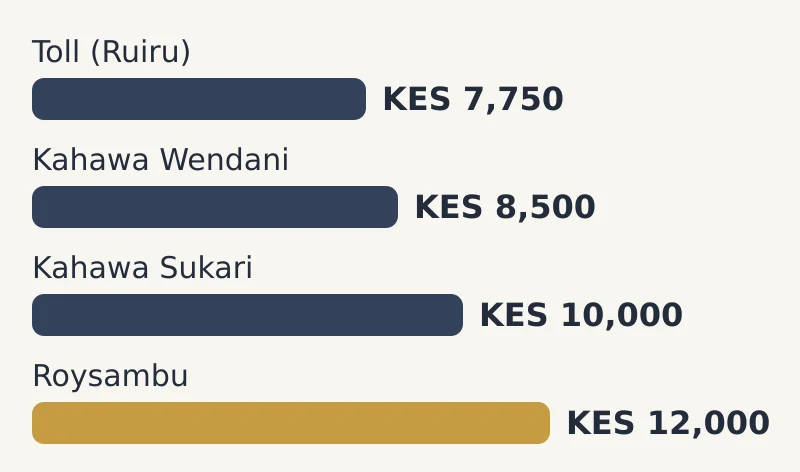
All figures are median monthly rent. Move-in in these areas is about double the rent.
- Toll (Ruiru) - the lowest rents in our listings. Worth a look if you can handle a longer commute.
- Kahawa Wendani and Kahawa Sukari - bedsitters and 1 bedrooms in a range many graduates can manage. Sukari runs a little higher.
- Roysambu - closer to the city, so rents are higher than the Kahawa areas and Ruiru.
For comparison, Kilimani 2 bedroom apartments on ISHI Homes had a median rent of KES 71,500 a month, with typical move-in of KES 214,500, as of 25 Oct 2026. That is a good example of how much location changes the price.
How to choose an area
Do not choose on rent alone. Check:
- Your commute - do the trip to work at rush hour before you sign. Note the cost and time.
- Water supply - ask neighbours how often water runs and whether there is a tank.
- Security - look for a gate, a guard or secure entry, and good lighting at night.
- Shops and services nearby - where will you buy food and household items?
- The road - visit after rain if you can, to see if the access road floods or gets muddy.
Talk to people who already live there. A neighbour will often tell you more in five minutes than an agent will in an hour.
How to spot rental scams
Scammers target first-time renters because they are in a hurry and do not know the process. Watch for these warning signs:
- They ask you to pay before you see the house. This is the biggest red flag.
- A "viewing fee" or "booking fee" to see or hold a house.
- The price is much lower than similar houses in the same area.
- Pressure to pay now - "many people want this house, send money today."
- They cannot show you inside - the "tenant still has the key" or the "landlord is away".
- Payment to a personal number with no receipt or written agreement.
- Photos that look too perfect or appear on other listings with different details.
Protect yourself
- View the house in person, inside and out.
- Meet the landlord or the official property manager, and ask for their name and contact.
- Ask neighbours or the caretaker who owns the building and whether the house is truly vacant.
- Read a written tenancy agreement (the contract between you and the landlord) before paying. Check the rent, deposit, notice period and what happens to your deposit when you leave.
- Pay to a business account or paybill linked to the property where possible, and keep every receipt and M-Pesa message.
Your checklist on viewing day
- Turn on taps and flush the toilet.
- Test switches and sockets.
- Look for damp, cracks, leaks and pests.
- Check doors, windows and locks.
- Check phone signal inside the house.
- Take photos of any damage and share them with the landlord before you move in, so it is not taken from your deposit later.
Before you pay anything
- Never pay before viewing. No genuine landlord needs your money before you have seen the house.
- View the house in person. Photos and videos are not enough.
- Find verified houses on ISHI Homes at homes.ishi.digital, and compare prices across areas before you decide.